

%20(1).jpg)
Published:
Apr 22, 2024
Updated:
February 9, 2026

Learn about California's SB 253 (CCDAA) compliance and implementation timeline. Effective 2026, this law mandates standardized greenhouse gas reporting for companies with $1B+ revenue.

On October 7, 2023, California Governor, Gavin Newsom, signed two bills related to ESG reporting. This article focuses on the Climate Corporate Data Accountability Act (CCDAA), which mandates that the California Air Resources Board (CARB) develop requirements for greenhouse gas reporting. For more information on the other bill, the Climate-Related Financial Risk Act (CRFRA), see our article here.
The CCDAA sets ESG reporting standards that affect all entities that meet the criteria for doing business in California and have annual revenue in excess of $1 Billion. The revenue amount to be considered will be the lesser of the entity’s two previous fiscal years.1 For covered companies, Scope 1, 2, and 3 greenhouse gas emissions must be reported according to Greenhouse Gas Protocol standards. For more information on Greenhouse Gas Protocol see our article here.
Emissions data will be filed with the state board or an emissions reporting organization. Individual company data and aggregate data will be publicly available through a digital platform. The State Board will contract an academic institution (university or laboratory) to aggregate and analyze the data.
What are Scope 1, Scope 2, and Scope 3 emissions? According to the CCDAA, these classifications are defined as
While each classification of emissions will require additional measurement practices, Scope 3 emissions will require the most time and capital to track. The extra year of preparation (2026 for Scope 1 and Scope 2 vs 2027 for Scope 3) will allow companies to prepare for these detailed reporting requirements.
After the California State Legislature passed SB 253 and SB 261 in 2023, it passed SB 219 in 2024 as an amendment to both laws. Key changes to SB 253 are included in the list below.2
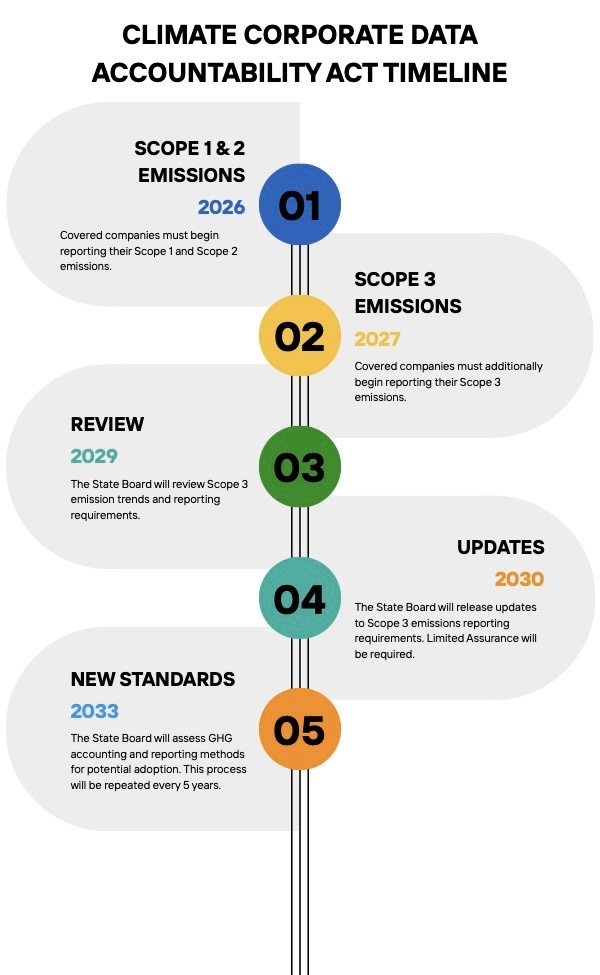
It is important to note that the proposed timeline may continue to change over time; this is only a current estimate of CARB reporting deadlines.
In order to be compliant, emissions data will need to be assured by an independent third party. From 2027-2030, Scope 1 and Scope 2 emissions should be assured at the limited assurance level. Beginning in 2030, Scope 1 and Scope 2 emissions need to be assured at a reasonable assurance level. A reasonable assurance level requires a more extensive testing and evidence gathering process than a limited assurance level.
Scope 3 emissions must be disclosed beginning in 2027, but there is no assurance requirement until 2030, when a limited assurance level should be performed. The CARB announced that Scope 3 emission disclosures made with “reasonable basis and disclosed in good faith” will not be subject to penalties.
Assurance providers should have “significant experience in measuring, analyzing, reporting, or attesting to the emission of greenhouse gases and sufficient competence and capabilities necessary to perform engagements in accordance with professional standards and applicable legal and regulatory requirements.”
In-scope entities for SB 253 are required to pay an annual fee to the CARB to fund the administration and implementation of the law. The proposed regulations that have been released provide a walkthrough on how the annual fee will be calculated.6 The CARB has clarified that every entity that is in-scope of the law is required to pay the fee. This means both subsidiaries and parent companies will be required to pay the fee individually.7 The filing fee is expected to begin in 2026 and continue annually thereafter. As the CARB is also responsible for enforcing the new regulations, it may impose penalties of up to $500,000 under SB 253 for late filings, non-filings, and other failures to comply with the law.8 The filing fee is expected to begin in 2026 and continue annually thereafter.
In an attempt to help companies in their good faith efforts to comply with the reporting requirements, the CARB has released a draft GHG reporting template for voluntary use in the 2026 reporting cycle.9 The template is in an excel format and includes sections for companies to provide information related to their organization, inventory boundary, emissions disclosures, methods, de minimis sources and other relevant fields. If a company chooses to use the provided template everything included in the template should be filled out.10 The feedback window for the draft template closed 27 October 2025, so a finalized version could be released at a future date.
In addition to the draft reporting template, the CARB has also released a preliminary list of companies it believes are in-scope for both SB 253 and SB 261.11 The list was created using public information and tax records available in the state of California, and is meant to be helpful rather than determinative. Working with legal counsel to determine a company’s eligibility would be advised for those that fall close to the threshold and do not qualify for exceptions.
Although no official regulations have been released yet, reporting will start in 2026, so it is essential that companies begin preparing to the best of their abilities now.
Companies that have previously released voluntary ESG reports, including their GHG emissions, should review their process and ensure that they will still be compliant with the new requirements. Reviewing your reporting governance structure could be beneficial to ensure that all members that need to review the report before issuance are included.
For reporting entities who have not reported their emissions before, it will be important to establish controls around your data collection, storage, and use. Additionally, early engagement with an assurance provider will help your company in understanding the scope and timing of the assurance process. Your provider can also help you establish a smoother process up front by ensuring you have the necessary documentation and evidence required by them to provide a conclusion. In brief, start the process now to ensure you are compliant when the reports are due.
Additionally, for foreign entities with in-scope subsidiaries, the CARB staff has clarified that a foreign parent company may submit a consolidated report on behalf of its in-scope U.S. Subsidiaries, as long as it provides the required reporting information.12
The Climate Corporate Data Accountability Act represents a significant step forward in regulating greenhouse gas emissions reporting for large entities operating in California. With its structured approach, the CCDAA mandates reporting of Scope 1, Scope 2, and Scope 3 emissions, ensuring comprehensive transparency in environmental impact assessment. By setting rigorous standards, the CCDAA underscores California's commitment to addressing climate change and promoting sustainable business practices. While these reporting requirements appease many environmentalists, most corporate executives are concerned about the cost and time required to comply with the CCDAA.
This has resulted in companies fighting the legislation through court and other efforts.As recently as August 13, 2025, the U.S. District Court for the Central District of California denied a request for a preliminary injunction against SB 253 and SB 261, meaning the reporting requirements for both laws had remained on schedule.13 These efforts to circumvent or delay compliance have only continued with the U.S. Court of Appeals for the Ninth Circuit issuing an injunction on SB 261 in November, putting its enforcement to a temporary halt while waiting for the appeal process. On January 9 oral argument regarding SB 261 and SB 253 took place. While litigation continues, no stay has been issued for SB 253, and it remains on schedule for 2026 implementation.14 15
1. BDO: California Rule makers Provide Updates on Senate Bills (SB) 253 & 261
2. EY Technical Line: A closer look at California’s recently enacted climate disclosure laws
3. CARB FAQ page as of November 17th
6. Article 6: California Climate Disclosures
7. KPMG Webcast: California Climate Laws - final countdown without regulations
8. PWC Viewpoint: California climate reporting – SB 253 and SB 261 explained
9. CARB GHG Draft Reporting Template as of October 2025
10. KPMG Webcast: California Climate Laws - final countdown without regulations
11. CARB Preliminary list of in-scope companies
12. KPMG: All about California’s climate laws
14. KPMG, All About California Climate Laws
15. Pillsbury Law: Ninth Circuit Oral Argument Highlights – Challenges to California Climate Disclosures