Published:
April 23, 2026
Updated:
August 26, 2026

Learn how renewable PPAs support net‑zero goals, how physical and virtual PPAs function, and what companies must consider when accounting for these contracts.

Climate change not only affects our environment but also our economy. Climate-related risks can have substantial effects on the cash flow of a company. In recent years, companies such as Google and Meta have committed to net-zero carbon emissions to mitigate the negative consequences of climate change.
To mitigate carbon emissions, companies are entering into renewable power purchase agreements or renewable PPAs. Meta signed a 20-year PPA with Vistra Corp for 2,176 megawatts of nuclear energy. Google signed with Clearway Energy Group for PPAs totaling 1.17 gigawatts. Renewable PPAs are key contracts that move companies toward cleaner energy.
This article is intended to introduce PPAs and provide a high-level overview of considerations when accounting for them. For further guidance, entities should consult with qualified accounting professionals, as PPAs can be complex and nuanced.
Power purchase agreements (PPAs) are long term electricity supply contracts that determine type, price, and quantity of energy in advance. Understanding how energy is supplied to facilities and companies is key to understanding how PPAs operate.
Most of the energy consumed by companies comes from the grid unless they are directly connected to a generator. The grid consists of various types of energy generated from sources such as gas, coal, and renewable. As a result, renewable energy produced by power plants is typically consumed through the grid. Since renewable energy is mixed with conventional energy, it is not possible for companies to track the sources of the energy they consume from the grid. Renewable PPAs help address this challenge. Companies enter into contracts to buy renewable energy from a generator or power plant to track the renewable energy they consume. There are two main types of PPAs: physical and virtual.
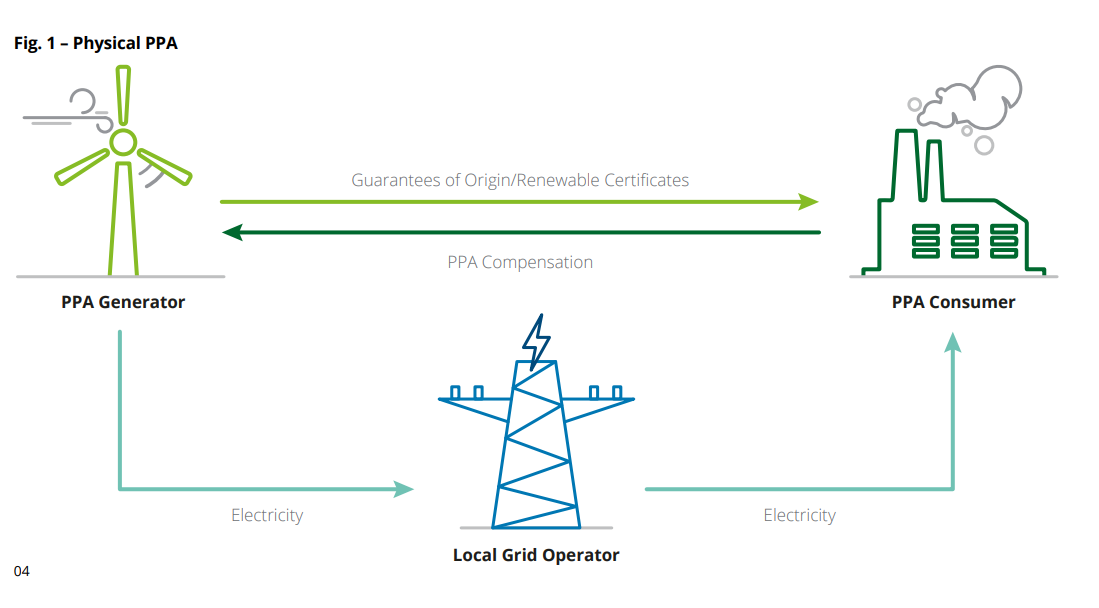
Physical PPAs represent the physical delivery of electricity. Typically, to transfer energy an interconnection point is created between the company’s facilities and either the grid or the transmission system, resulting in physical delivery. Another instance that qualifies as a physical PPA, is delivery through an intermediary where a company purchases electricity from its chosen energy generator and then sells it into the grid. The purchasing company then is obligated to instantaneously buy the same amount of electricity from the grid in which the electricity was contributed, resulting in a physical transfer of energy. Lastly, a physical delivery can be the delivery of electricity to a customer’s account on the grid, meaning they do not have to pay the local grid for electricity consumption.
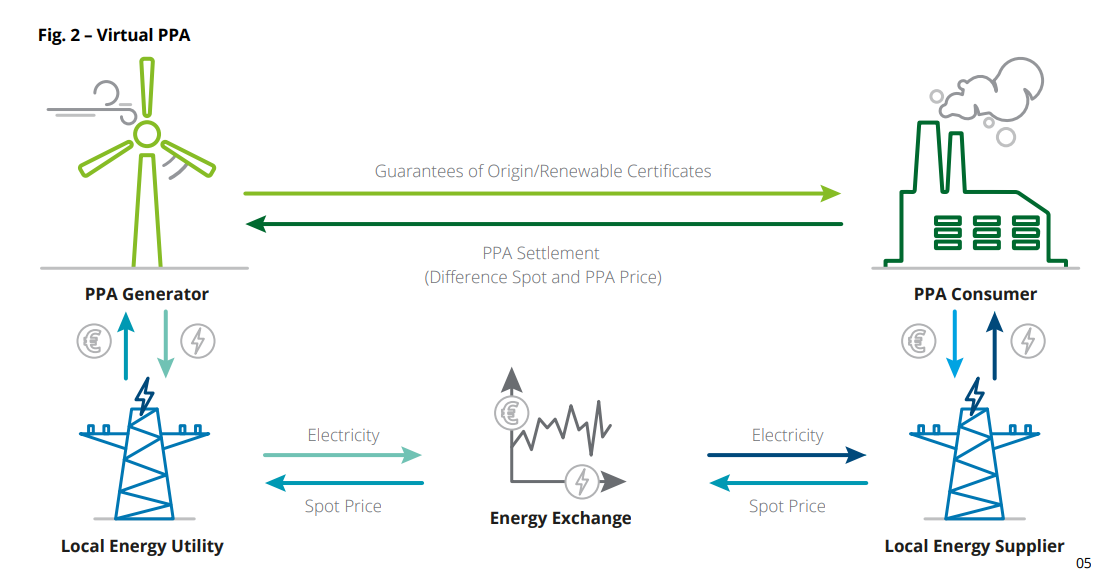
Virtual PPAs, on the other hand, resemble financial contracts. In various cases, there is a significant geographical difference between the location of green energy generation and the physical location of the consuming company. These contracts do not represent a physical exchange of energy but instead exchange on price. Virtual PPAs generally have both a spot price and a fixed price. The contract specifies a fixed price at which the company purchases energy, which is then later reconciled to the spot price through a cash settlement. Virtual PPA contracts are typically used to hedge against volatile energy prices and obtain RECs.
In some instances, renewable PPAs also generate RECs or renewable energy certificates. Renewable energy certificates are instruments representing environmental attributes of one mega-watthour of generated renewable energy. Since the grid contains renewable energy and other types of energy, RECs allow companies to verify and claim renewable energy use. These RECs are accounted for separately, more guidance and information on how to account for RECs can be found here.
The accounting considerations for PPAs generally remains the same across GAAP and IFRS, however outcomes of applied standards are different. Whether a company is using GAAP or IFRS, they first consider the elements of the PPA and determine if it is a lease agreement or contains an embedded lease. If no lease is determined to exist, companies move onto derivative and hedge accounting considerations. If there is no derivative in the arrangement, the company determines the appropriate route to take depending on the present contract elements. For GAAP, this means executory contracts.
Leases, as defined by ASC 842, are “a contract, or part of a contract, that conveys the right to control the use of identified property, plant, and equipment for a period of time in exchange for consideration.” The first step is to assess whether the contract falls within the scope of lease accounting as outlined by ASC 842-10-15-1. Exclusions from lease accounting include leases of intangible assets, exploration for use of minerals, biological assets, inventory, and assets under construction. In relation to PPAs, these agreements are most often considered to be within the scope of lease accounting.
From there, the arrangement needs to be evaluated to determine whether it contains a lease. The codification states, “A contract is or contains a lease if the contract conveys the right to control the use of identified property, plant, or equipment (an identified asset) for a period of time in exchange for consideration.” Thus, the main question becomes whether a company has the right to control the use of an identified asset. When determining its right-of-use within PPA contracts, the two main considerations are the company’s ability to identify the asset and its ability to control the use of the identified asset.
For there to be a lease, the contract must have an identified asset (e.g., power plant). This means that a PPA must explicitly state from which plant it is utilizing its energy. Otherwise, further steps are needed to identify whether there is an implicitly stated asset. If no explicit or implicit plant is identified within the PPA, then it cannot be accounted for as a lease. Additionally, any identified asset must be physically distinct according to the codification in ASC 842-10-15-16.
Furthermore, an asset is an identified asset only if the electricity supplier does not have substantive substitution rights over it. The right to substitute an asset is substantive only if the supplier has the ability to substitute alternative assets through its use, such as replacing the power plant, and would benefit economically from the asset’s substitution. If substantive substitution rights are present, then the contract in question does not have an identified asset.
After an asset is identified, the next hurdle is to determine whether the company has the right to control the asset.
ASC 842-10-15-4 summarizes the requirement for a company to control the use of an identified asset. It states:
“To determine whether a contract conveys the right to control the use of an identified asset for a period of time, an entity shall assess whether, throughout the period of use, the customer has both of the following:
a. The right to obtain substantially all of the economic benefits from use of the identified asset (see paragraphs 842-10-15-17 through 15-19)
PPAs are considered leases if the company essentially has the rights to all of the power plant’s economic benefits and directs its use. It is noted that a more extensive evaluation of a PPA is often needed to determine who controls the asset because the evaluation can be complex, so professional guidance is advised.
If a PPA, or parts of it, is deemed a lease, the next step is to determine the type of lease, which affects how it is accounted. Operating leases recognize a right-of-use asset and report a lease liability on the balance sheet. The total lease costs are expensed on a straight-line basis over the term on the lease. Finance leases also recognize a right-of-use asset and lease liability. However, the interest in the finance lease liability is expensed as interest and the right-of-use asset is amortized separately, leading to higher expenses in earlier periods of the lease. For further guidance regarding the classification of the leases and the related consequences find our article here.
If a power purchase agreement is determined to be out of scope or does not meet the requirements for lease accounting, companies should consider whether the PPA is or contains a derivative. Since derivative accounting is complicated, only a basic overview of what to consider is provided in this section.
A derivative is a financial instrument whose value is not inherent but “derived” from an underlying variable. It must contain an underlying, notional amount, payment provision as well as zero to little initial net investment and must permit net settlement. Virtual PPA contracts are more likely to be included in the scope of derivative accounting because they represent a price exchange, however most Virtual PPAs are not derivatives under GAAP because they have no notional amount. Physical PPAs are rarely classified within the scope of derivative accounting because they represent a physical exchange of electricity rather than a cash flow and can also be exempt due to the “normal purchase, normal sale” rule within ASC 815. The purpose of derivative contracts is to settle differences between the spot and fixed price of electricity through cash, meaning as the market fluctuates in price the cash settlement changes in response.
Once a PPA is deemed to be or have a derivative, the initial measurement of the derivative on the balance sheet is recorded at fair value. As its value changes, these changes may flow through different line items of the financial statements depending upon its classification. In the context of PPAs, hedging refers to reducing and managing financial risks to the cash flow and earnings of a company arising from price fluctuations. Cash flow hedges direct gains and losses produced from fair value changes to accumulated other comprehensive income (AOCI), shielding the income statement from volatility. To further dive into the classification and effectiveness of derivatives, see our article here.
In the event that a power purchase agreement does not fall under lease or derivative accounting, the PPA in question is generally accounted for as an executory contract or purchase obligation. No asset or liability is recognized on the balance sheet for these contracts. Instead, the contract is accounted for as the parties perform under the contract. These are contracts that do not qualify for derivative accounting and therefore entities do not record fair value adjustments for the contract.
Below is a summary showcasing the differences to the bottom line between lease, derivative, and executory contract accounting.
| Type | Balance Sheet | Income Statement |
|---|---|---|
| Lease | Recognize a Lease Liability and Right-of-use asset | Operating: Expensed over term of lease Financing: Interest expense (based on carrying value of liability) and amortization expense (straight-line expense of asset) |
| Derivatives | Derivative instrument recorded at fair value | Changes in fair value flow through the income statement unless hedge accounting is applied Cash flow hedge: Changes in fair value recorded through other comprehensive income (OCI) |
| Executory Contract | No recognition | Accounted for as the parties perform under the contract |
Power purchase agreements can be challenging to report because they are longterm agreements. However, the most complicated challenge in accounting for PPAs arises from assessing whether it is a lease, derivative, or other type of contract. Lease and derivative accounting are complex and require significant judgment. Additionally, there is the burden of disclosing accounting methods. From fair value measurements to estimations of future benefits, accounting for PPAs is time consuming and will continue to grow complicated as PPAs increase in number and standards change.
About half of the Forbes Global 2000 companies have pledged netzero emission targets, including Microsoft, Apple, Google, and IKEA. In addition, 107 countries have committed to the same pledge of becoming net zero. A net-zero commitment means reducing carbon emissions as much as possible while offsetting the remaining emissions. Essentially, it is balancing carbon emissions with clean energy generation; “removing” what you're putting into the atmosphere, so the net effect is zero.
The United Nations advises organizations committed to net-zero targets to completely transform their operations and create a sense of urgency to reduce greenhouse gas emissions. These recommendations highlight the importance of mitigating climate change and its effect on both the planet and businesses. Since the energy sector represents about 75% of greenhouse gas emissions, the biggest opportunity for progress toward net-zero is replacing fossil-fuel generation with renewable sources of energy.17
Renewable PPAs are closely aligned with a company’s commitment toward net zero. These contracts most commonly represent the purchase of renewable energy, providing companies with access to green energy. By entering into renewable PPAs, a company eliminates or avoids their carbon emissions produced through energy generation. Avoided emissions can be achieved through virtual PPAs, where the company is not directly using renewable energy, but the purchased green energy enters the grid for others to use. Carbon emissions can also be eliminated through physical PPAs, where the company can directly use the energy produced through renewable energy plants. Both of these methods enable a business to claim clean energy use and reduce their carbon footprint.
One criticism of this approach is that it can be misleading. A company may report lower carbon emissions while continuing to rely on the same energy sources and producing the same amount of carbon. In such cases, the company has purchased clean energy and contributed renewable energy to the grid, but it has not necessarily changed its own operations. In this instance, while clean energy use has increased, the company itself is not directly reducing its emissions; one of the main goals of net-zero targets.
However, renewable PPAs ultimately contribute more green energy to the grid, allow for more clean energy use, and result in increased investments in renewable projects. Not only this, PPAs support renewable energy plants and essentially fund their operation and development in the long run. As such, PPAs are valuable tools that can complement a company’s efforts to reduce carbon emissions.
As businesses move toward sustainable solutions to mitigate climate change, renewable power purchase agreements have proven to be a valuable instrument. These long-term contracts enable companies to secure reliable renewable energy supply and, in some cases, hedge against the volatility of energy prices. In addition, renewable PPAs enable companies to progress toward their net-zero commitments. When utilized effectively, renewable PPAs can be powerful tools not only for the bottom line, but also for creating meaningful impact on climate change.
Other Sources